
Betting, Broadcasting and Big Tech: The Legal Battle Over Real-Time Sports Data in India
- Jun 5
- 6 min read
Introduction:
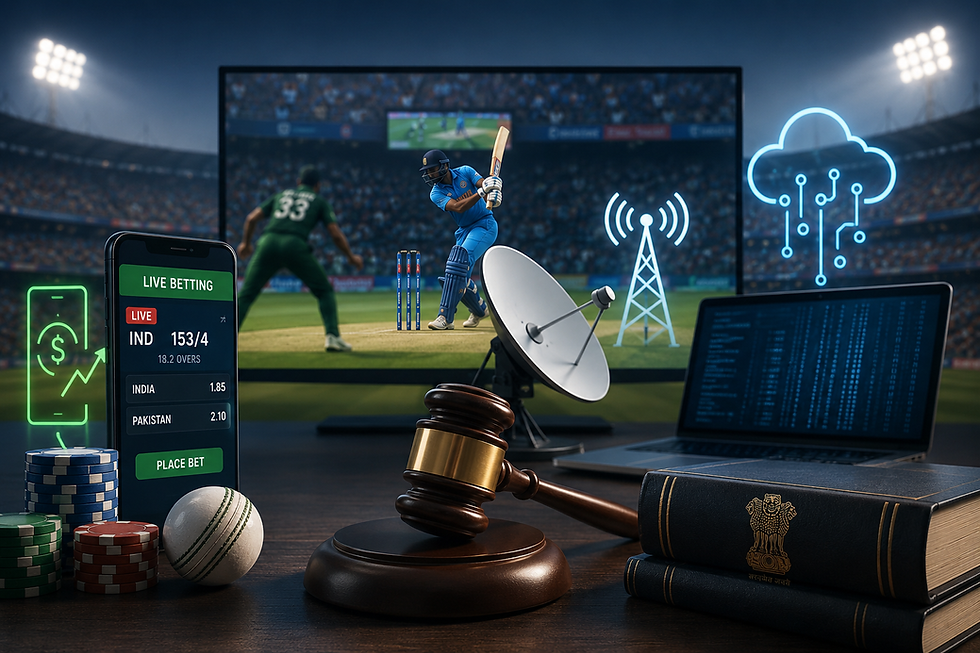
In today’s sports economy, live data has become an asset nearly as valuable as the sporting event itself. Real-time score, ball-by-ball, predictive analytics, players' performance, and advanced statistics now power fantasy sports platforms, betting markets, analytics companies, and media houses. Beneath all of these billion-rupee deals is another commodity, legally in a gray area, but commercially indispensable for all sports: real-time sports data.
This raises an important question of law in sports as well as in media and entertainment law: who is the owner of live sports data? Match data should not be able to be used for commercial purposes by anyone other than the organizers Or are such statistics and facts part of the public domain?
The Commercial Nature of Sports Data:
Sports data nowadays serves as the backbone of several revenue streams. Official data feeds are licensed to broadcast channels, analytics companies and gaming platforms. These feeds are often the granular types of data sets, like contextual strike rates, wagon wheels, pitch maps, and predictive win probabilities generated through algorithmic tools. Event organisers spend a lot of money and technology on gathering, verifying and distributing such information in real time. This kind of commercial value has led to disputes between event organisers and third party operators regarding who actually owns and controls sports data. This further gets complicated since everyone claims first ownership of such data.
Copyright Law and Question of Originality:
Under Section 13 of the Copyright Act 1957, copyright subsists in the original literary work. The Supreme Court in Eastern Book Company v DB Modak explained that the threshold for originality is a "modicum of creativity" and it abandoned the "sweat of the brow" doctrine, which protected mere labour and effort. This decision considerably restricts protection for compilations and databases.
Applied in the instance of sports data, this principle draws an important distinction. Individual statistics such as the number of runs scored or goals conceded are bare facts. Facts, by their nature, cannot be copyrighted. Therefore, an update to a score does not attract copyright protection. However, an organized and imaginatively arranged database can be a literary work if there is sufficient intellectual creation expressed in either selection or arrangement.
Even if a database can qualify as a literary work, the basic facts at its core are still in the public domain. So an independent gathering , of those facts may dodge copyright infringement.
Comparative Perspective: The European Union Approach:
A look at the European Union in comparison shows a different approach in legislation. In the case of Football Dataco Ltd v Yahoo! UK Ltd, the Court of Justice of the European Union ruled that football fixture lists did not possess the requisite originality to be protected under copyright law. Separately, the EU Database Directive contains a sui generis right granting protection to substantial investment in obtaining, verifying, or presenting database contents.
Unlike the EU, India does not have a sui generis database right, so it largely leans on contracts, licensing arrangements and tech safeguards. In practice it means, there’s more reliance on deals and controls than on any single special database protection.
Broadcast Rights and Their Limits:
Unlike sports data, broadcast signals are protected fairly clearly by statute. Section 37 of the Copyright Act reflects broadcast reproduction rights and gives exclusive control over their signals to the broadcasters. The Indian courts have been strict in enforcing these rights. In Star India Pvt Ltd v Piyush Agarwal, the Delhi High Court restrained unauthorised streaming of broadcast content, thereby affirming the enforceability of rights in Broadcast reproduction.
However, when it comes to doctrinal differences, a distinction must be maintained between a broadcast signal that is protected and the factual events that are depicted in that broadcast. If a betting operator makes a copy of an audiovisual feed, infringement is obvious. Conversely, if the operator separately records and disseminates statistics about the outcomes of matches without copying protected audiovisual content, he may try to argue that he is simply engaging in the sale of unprotected facts. This distinction reveals the shortcomings of simply keeping only broadcast rights in the hands of the content creators in order to control the exploitation of the data downstream.
Sports Betting, Low-Latency Data, and the Rise of Data Intermediaries:
The worth of immediate sports data becomes more apparent through its application in sports betting markets, where even minor time differences impact betting results. The contemporary betting system depends on data feeds that deliver real-time information to bookmakers and betting exchanges, and online gaming operators with minimal time delay. The transmission of scores or events must occur without any delay because even a single second of interruption will create opportunities for arbitrage, while it distorts betting odds and brings financial losses to operators. The need for official data feeds that provide betting companies with superior speed and reliability to public broadcasts has become essential for betting companies.
The creation of intermediaries demonstrates how "big tech" companies have started to control sports governance. The event industry now depends on technology companies and data vendors to connect event organizers with broadcasters, fantasy sports platforms, and betting operators. The companies provide live statistics together with predictive analytics, which they use to distribute APIs that enable complete digital sports ecosystems to operate. The companies use their data infrastructure control to determine access rights and licensing fees, which affect how markets operate.
In India, sports betting faces strict regulation, which prohibits most betting activities except for specific situations allowed by law. Offshore betting platforms use Indian sports data, especially cricket statistics, for their operations. The Indian sports industry generates vast global data value, which stems from its athletic events, yet the country lacks a complete system to regulate sports data ownership and licensing.
Another important issue concerns the use of exclusive licensing agreements. Sports bodies now establish exclusive partnerships which provide specific organizations with single access to their official low-latency data streams. Organizers use these agreements to maximize their revenue streams, but they create obstacles that prevent smaller fantasy sports operators and analytics companies, and new gaming platforms from obtaining official data access. Exclusive licensing, therefore, raises broader concerns regarding market concentration, data monopolisation, and competitive fairness within the digital sports economy.
Fantasy Sports and the Expanding Data Economy:
The sudden proliferation of fantasy sports platforms like Dream11 only shows the economic importance of sports data. Judicial recognition of fantasy sports as games of skill in Varun Gumber vs Union Territory of Chandigarh gave legitimacy to a sector that is heavily reliant on the statistics of player performance and performance metrics.
While the legality of fantasy gaming models has been studied by the courts, no direct court action has been taken in relation to proprietary claims over real-time sports data. As regulatory supervision over online gaming grows in India, some of the questions related to exclusive data licensing, barriers to access, and the right to fair competition are likely to become more prominent.
The “Hot News” Doctrine and Its Possible Relevance:
In the United States, the Supreme Court, in International News Service v Associated Press, recognised a quasi-property right in time-sensitive news under the "hot news" misappropriation doctrine. The doctrine prevents competitors from free-riding on costly news-gathering efforts.
The hot news doctrine is not officially recognised in Indian law. Nonetheless, non-discrimination cases have occasionally been heard by the Indian courts based on allegations of misappropriation and unfair competition. Sports organisers could make an argument that commercial replication of match data in real time destroys the economic incentives needed to organise sporting events. Whether Indian courts would follow such reasoning is still an open question, especially as judicial caution towards extending beyond the text of the statute the scope of intellectual property protection.
Competition Law Considerations:
Leaving real-time sports data to only one provider may also raise competition law concerns. Courts in the past have explored how it has monopolized the role of governing a specific sport, such as cricket, in Surinder Singh Barmi v Board of Control for Cricket in India. Assuming that access to official data is essential to participate in fantasy sports or betting markets, the refusal to license access to such data on reasonable terms will attract scrutiny under Section 4 of the Competition Act 2002.
Accordingly, it is necessary that any move towards the recognition of exclusive proprietary rights in sports data must be properly balanced with measures to prevent the abuse of dominance.
Conclusion:
The legal question about who owns real-time sports data in India requires more than copyright law to find a resolution. Indian copyright law establishes that raw sporting facts and scores and player statistics do not meet the criteria for protection as original works. The only aspect that can be protected involves the artistic arrangement of data through creative methods, which include compilation and presentation. Sports organizers who invest money into an event cannot claim full ownership rights to the basic facts that take place during a match.
Author: Mahek Shah is a fifth year BBA LLB (Hons.) student at UPES, Dehradun


Comments